01 · The adventure
Thirteen hours to reach Jareth
The game opens on a city block outside a movie theater. You name your character, answer the setup questions, and explore the streets in text, with two word wheels that hold the verbs and the objects.2 The ticket counter will not let you in without a ticket, which costs five dollars ($90F4, $9327). The popcorn stand has a trick of its own: the menu asks $1.25, but the woman takes two dollars and leaves two quarters in change ($93E1). Walking into the cinema is the way into the maze, and the text adventure follows each step.
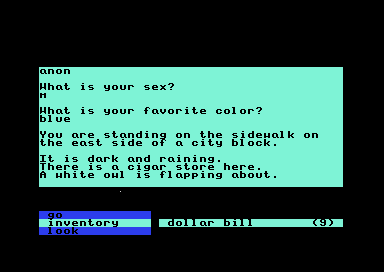 The city opening: the street described in text, with the action and object wheels below. Captured from the supplied disk.
Inside the maze the story is a race. The Player’s Guide sets the goal: reach Jareth before thirteen hours expire.1 The clock counts in whole hours, and some actions spend them: at the Wall of Hands, the eighth manicure takes one hour, and a game with no hours left ends ($0C61). You steer the character with joystick port 1 along the walls of each room, and the same wheels give the commands. Controls covers both.
The maze begins at the entrance gate, which leads to the first corridor. Its exits open into the Brick Hallway, a row of doors where your position decides which you can open. Beyond it, two guards claim that one of them always lies and the other tells the truth, and they will not say more until you have opened every door in the hallway. A random bit set when their room loads changes what the two doorways do; in the recorded route, the right doorway ends in a fall. The Wall of Hands follows, where the manicure command needs shears, and then the Stone Corridor with its door, arch, and ladder.
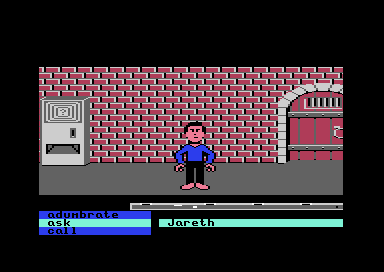 The Brick Hallway, reached through the entrance gate and first corridor. Movement and commands share the scene.
02 · The release
Lucasfilm Games’ adventure
Lucasfilm Games made Labyrinth, based on Jim Henson’s film and published by Activision in 1986. The disk’s credits name David Fox as production manager and programmer, Charlie Kellner as technical director and lead programmer, and Gary Winnick for character animation and background art. David M. Martin Jr. is credited with the music and Commodore sound.1
 The loading screen: the Lucasfilm Games logo. Captured from the supplied disk.
This explanation follows the two-sided English Commodore 64 disk edition, which keeps three game slots. The About page names the copy studied and the sources.