1986 · Micro Power
About this page
The copy studied
The copy is a single program file of 29,175 bytes. It unpacks itself and starts the game straight into play, with no title screen, menu, or trainer ($484D). Its memory still holds the original release's loading picture ($0400) and a small loader routine that printed "PLEASE WAIT -- STILL LOADING" ($7F00).
The steward later supplied the original disk.10 Its boot program shows a title screen, plays a title tune, offers to load a saved position, and then loads the game in three parts. Stopped as it hands over to the game at $484D, the disk's memory matches the program file in every byte the listing holds, apart from zero page and a scratch area at $FF70, which hold whatever each loader left there.
Footprint
Every byte of the C64's 64 KB, one pixel each, 512 to a row. Lit pixels are what this game is: its code, graphics, level data, sound, text, tables, and variables, exactly where they sit in memory. Dim areas are screen and working memory; dark is unused.
| What | Bytes | Of 64 KB |
|---|---|---|
| Program | 58,309 | 89.0 % |
| Code | 18,873 | 28.8 % |
| Graphics | 13,133 | 20.0 % |
| Level data | 11,385 | 17.4 % |
| Sound | 4,387 | 6.7 % |
| Text | 1,944 | 3.0 % |
| Tables | 6,767 | 10.3 % |
| Variables | 1,820 | 2.8 % |
| Screen, bitmap, colour, stack, I/O | 5,504 | 8.4 % |
| ROM the game runs under | 1,328 | 2.0 % |
| Unused | 395 | 0.6 % |
Status
| Tier | silver (claimed) |
|---|---|
| Coverage | 100 % of the bytes the game uses have a description |
| Build analysed | single packed program file, 29,175 bytes, SHA-256 8d143c7ac59882fe54844aa41d9996679e35bb100932e80f851191a3afb889bb |
| Copy | agent-draft |
| Tools | emulator: release v3.13.1, v3.13.1-linux-x86_64-gui.zip (vice-mcp), disassembler: regenerator2000 0.9.20, host: Linux 6.18 (Ubuntu 24.04 cloud container, no display), x86_64 Intel Xeon, browser: Chromium via Playwright 1.56.1, headless |
| Model | claude-opus-5-5 (Claude Code, lead and seven annotation subagents) |
| Kit version | 0.0.44 |
Contributors
Other places to love this game
- Doctor Who and the Mines of Terror – Wikipedia
- Game of the Week: Doctor Who and the Mines of Terror – GameBase64
- Doctor Who and the Mines of Terror (video game) – Tardis Data Core
- Doctor Who and the Mines of Terror playlist – YouTube
Sources
- GameBase64, "Game of the Week: Doctor Who and the Mines of Terror", which reproduces Zzap!64's review of the Commodore version from issue 13 with its scores, read 2 October 2026: the story, Splinx, the prices, and the reviewers' words.
- The Internet Archive's entry for the Amstrad CPC release, read 2 October 2026: the Rijans, madrags, and guards.
- Wikipedia, "Doctor Who and the Mines of Terror", read 2 and 3 October 2026: the aims, the robots that look like Daleks, the release years, the ROM chip, and the Zzap!64 issue date.
- Gary Partis, interviewed by Stuart Goodwin for Stairway to Hell, autumn 2007: how the game came about, the ROM, and Micro Power's finances. The interview is about the BBC Micro original.
- Wikipedia, "Micro Power", read 2 October 2026: Bob Simpson, Leeds, and the company's Commodore 64 games.
- Frank Gasking, "Doctor Who and the Mines of Terror", Games That Weren't, January 2022: the unreleased Spectrum version, Bob Simpson's explanation, and the Commodore Force mix-up.
- Tony Smith, "Antique Code Show", The Register, 7 November 2013: the promotion and the cost of development.
- Sinclair User 45, December 1985, page 133, as transcribed by the Doctor Who Cuttings Archive, read 3 October 2026: what TIRU stands for and what it does, and the guard robots. The article previews the game before the Commodore version.
- Euan (unorig), who stewards this page, from playing the game, 3 October 2026: how to take the PICK AXE from the Rijan miners and get past the madrag to the AIR MASK, and that the figure who comes for the CRYSTAL is the Master.
- The original Commodore 64 disk, from the steward's own copy (a disk image titled DWMT DISK MASTER, files DWMT, SCR, THEME, P1, P2, and P3), run in VICE on 3 October 2026: the title screen's credits, the boot program, the title tune, and the comparison with the program file.
- A walkthrough posted in thread 25786 of the Stardot forum, which the steward supplied on 3 October 2026. Stardot is a forum for Acorn computers, so the walkthrough is probably of the BBC Micro version; this page uses only what the Commodore code confirms: that Splinx can carry the crystal past the Master, and that the pipes stop moving when the machine is halted.
- Ken McMahon, review in Commodore User 29, February 1986, from a scan of the page the steward supplied on 3 October 2026: the package, the price, the scores, and the reviewer's words.
- J.G., review in Your Commodore 21, June 1986, from a scan of the page the steward supplied on 3 October 2026: the documentation, the music, the ratings, and the reviewer's words. The steward explained what each of the magazine's four rating icons measures.
- The review in Zzap!64 13, May 1986, by the reviewers initialled GP, JR, and GL, from a scan of the page the steward supplied on 3 October 2026: the prices, the scores, and the reviewers' words.
- The review in Computer and Video Games 55, May 1986, from a scan of the page the steward supplied on 3 October 2026: the price, the scores, and the reviewer's words.
- TARDIS Data Core, "Doctor Who and the Mines of Terror (video game)", which the steward supplied and which was read on 4 October 2026: the first game with the Sixth Doctor, and CYBAL, the language Splinx runs on.
What the game does, and where we found it
Read this before annotating code. What the game is documented to do, with verification status against the binary. Statuses: open (documented, not found yet), traced (in the code, could not be exercised; say what was tried), confirmed (in the code, consistent with the emulator), live (observed directly), differs (the code does something else). "Absent" is not a status.
Sources:
- The contributor allowed looking the game up online. On 30 September 2026 this session's network refused every game site it tried (C64-Wiki over HTTP and HTTPS, Lemon64, GameBase64, MobyGames, Wikipedia, Games That Weren't, archive.org, bbcmicro.co.uk, the TARDIS wiki). What is below comes from web search result summaries of those pages, read the same day, and is weaker than reading the pages: treat each row as a lead, not a statement.
- Search summaries of Wikipedia, "Doctor Who and the Mines of Terror", and of the Games That Weren't entry (2022): released by Micro Power on the BBC Micro in 1985 and on the Amstrad CPC and C64 in 1986; a ZX Spectrum version was developed and not released. Wikipedia (read 30 September 2026) also says it began as a sequel to the BBC Micro game Castle Quest and became a Doctor Who game mid-development, and that the BBC version came with its own ROM chip. The Games That Weren't page itself (read 30 September 2026) is about the Spectrum version; it opens with its author's own story that he had thought the C64 version unreleased, after a Commodore Force feature on unreleased games included it by mistake, until he found an original copy.
- Search summaries of the Wikipedia and GiantBomb pages: the Sixth Doctor and Splinx, a programmable robot cat; the Master is mining heatonite to build a TIRU; the Doctor recovers the plans and escapes. The Doctor can jump, climb ladders, press buttons, and throw or use items, and carries four items in his pockets. Deaths: monster attack, robot attack, too great a fall, forced regeneration, lack of oxygen, spikes.
- Search summaries of stardot.org.uk forum threads (BBC Micro version): the Master tries to take the TIRU crystal at the end, and getting it past him with Splinx's help earns a 4096 escape bonus; oxygen lets the Doctor go outside; cloth disables controllers that run over it.
- Reception, read 30 September 2026: GameBase64's Game of the Week page reproduces Zzap!64's review (April 1986, 86 %); Wikipedia adds the Castle Quest likeness; The Register (2013) gives the £14.95 price and the ROM chip, and says the development cost "did for Micro Power". Reviews of other versions (ASM's 4/10, of a version Wikipedia does not name; Amtix's 48 % for the Amstrad CPC) are left off the page: the contributor asked for C64 reviews only. Lemon64 and MobyGames refused the request.
- Key lists found by search (Z, X,
:,/, RETURN, U, P, I, C, E, H, F0) are for the BBC Micro version and do not match the C64's reader at$8F3C; the C64 keys below are read from that code. - The game's own screens: the Splinx Programmer screen (
reference/splinx-programmer.png).
Features
| Feature | Status | Where |
|---|---|---|
| Joystick in control port 2: left, right, up, down, fire | confirmed (left, right, fire live) | $8F3C |
Keys Z left, X right, ; up, / down, RETURN jump | traced | $8FD5-$9013 |
| F1 moves the pocket selector | live | $A530 |
| F3 puts an item in a pocket or drops a marker, or takes one out | confirmed (MARKER 4 shown live) | $A575, $A60C |
| F5 picks up the object in front, or uses the held item | traced | $A929, $BACC |
| F7 with a direction throws the held item | traced | $A7D7 |
| S opens the Splinx Programmer | live | $AF58 |
| A scrolling cavern map | live | $8C32, map $E000 |
| Ladders to climb | live (seen); climbing traced | $9D15 |
| Four pockets for items | traced | $3E-$41 |
| Score, six digits | live (000000) | $A50D |
| Figures beside the score are lives | live (five at the start, four after a death) | $94AC |
| Splinx follows the Doctor | live | $B3EF |
| Splinx programmer: modes, ten-step program, commands | confirmed (cursor live) | $AF58-$B16C, $B1A0 |
| Splinx battery drains and is recharged | traced | $B1EA, command 9 |
| Markers 1-4 placed in the mines for Splinx | confirmed | $A575, $42-$45 |
| Pick up, use, throw and drop items | traced | $A929, $BACC, $A6CB |
| Push buttons | traced: the code lock's three buttons | $BE29 |
| Robots and monsters that kill | traced: controllers (shock), madrag (bite), baby madrag | $CE5A, $B96F, $B902 |
| Death by falling too far | traced: a drop of $60 or more | $CD62 |
| Death on stalagmites | live | $CA67 |
| Oxygen needed outside | traced; live: no drain in the start cavern | $CA90 |
| Spikes | confirmed as the stalagmites: the game's own message says STALAGMITE, and the only terrain deaths are tiles $74/$51 (every $E8 writer was read); the steward confirmed descriptions' "spikes" mean these | |
| Forced regeneration | live (key R) | $9051 |
| Explosions | traced | $C09A-$C260 |
| Heatonite mining, TIRU, recovering the plans | traced: the end bonus asks whether production was halted and whether the CAPSULE (TIRU plans) was brought back | $9102-$920F, $B9B6 |
| The Master takes the TIRU crystal at the end; escape bonus 4096 | traced: object $0C goes after the CRYSTAL, from the Doctor or a pocket; the end bonus is 1024, doubled for the CRYSTAL and doubled for Splinx, 4096 with both, as the forum said. That $0C is the Master is not shown by the code | $B48A, $9163, $928C |
| Escape by TARDIS or escape pod, Time Lords' rating | traced | $9102 |
| Save to cassette or disc | traced; the game ends after saving | $94FF |
| Load saved games | traced: start-up restores a saved block in $7800; nothing in the program loads it | $49C6 |
| Music, five tunes by area | confirmed (live: music plays) | $74EA |
Beyond the documentation
- The status bar's font lives in the unused rows of its own screen.
- A code lock whose six-press sequence is dealt from a shuffled deck.
- The madrag guards two eggs and carries a moved egg back to its nest.
- Seven zones that each swap in their own character shapes.
- A countdown worth up to 10,800 points at the end that only ticks once every 21.8 minutes.
- Several tests that want an exact value: the carrier boards only at Y
$0450, the lift only at a height difference of 8.
Open questions
See facts.md, Open questions.
How the analysed state was reached
How to get from the contributor's own copy to the analysed state. Someone else must be able to follow this exactly.
The image
One program file, Doctor_Who_and_the_Mines_of_Terror.prg, 29,175 bytes, SHA-256 8d143c7ac59882fe54844aa41d9996679e35bb100932e80f851191a3afb889bb. It loads at $0801 to $79F6 and starts with a BASIC line SYS 2061. It is a single packed file, so it is not the publisher's release as it came off the disk: someone packed the game into one file. Whether any code beyond the packing was changed (a trainer, a removed protection) is examined in the sweep; no intro, menu or trainer appears on the screen.
From power-on to play
- Hard reset (power cycle) the emulator, PAL.
- Autostart the program file. VICE types
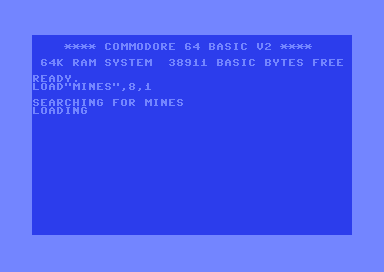
LOAD"MINES",8,1andRUN. - There is no title screen and no menu. About twenty seconds after the load begins, the depacker hands over to the game at
$484D, and a moment later play is on screen: the Doctor and Splinx the cat beside the TARDIS in a cavern, score 000000, six figures beside the score. - Snapshots, in
work/(never committed): entry.vsf: stopped on the game's first instruction,$484D(a stopping checkpoint on$484Dset before the depacker runs).play-start.vsf: a few seconds into play, no input yet.
The original disk
On 3 October 2026 the steward supplied an image of the original disk (.g64, 286,164 bytes, titled DWMT DISK MASTER). Autostarted, its BASIC boot program DWMT shows the title screen (SCR), asks LOAD A SAVED POSITION (Y/N)?, plays the title tune (THEME) until space is pressed, then loads P2, P3 and P1 and types SYS18509. A stopping checkpoint on $484D set before space is pressed catches the hand-over; there its memory equals the listing everywhere the listing has bytes, except zero page and $FF70-$FFFF. Snapshot work/dw-disk-entry.vsf.
Steady state
The start-up at $484D blanks the screen, stops CIA1 timer A, sets $01 to $35 (RAM at $A000 and $E000, I/O at $D000), and writes its own hardware vectors: IRQ $FFFE = $8010, NMI $FFFA = $800F. During play those vectors read $8010 and $800F and $01 reads $35. The KERNAL's RAM vector $0314 still holds $0888, which the game does not use while the KERNAL is banked out. Program-counter samples during play fall between $8000 and $CDFF.
The start-up copies blocks from $4B00 upwards onto the screen at $0400, so the hand-over image holds data the running game has since overwritten; entry.vsf is the image the listing is built from unless the comparison in the sweep says otherwise.
Emulator
release v3.13.1, v3.13.1-linux-x86_64-gui.zip, on Linux x86_64 in a cloud container with no display. check-emulator: 56 of 57, failed pause-at-instruction; stops are made with pause() from vice.py.
The loader, in a paragraph
The BASIC line jumps to $080D, which masks interrupts, blanks the screen, banks all RAM in, copies the decruncher into the stack page and zero page and runs it from $0100. It builds a 52-entry table of lengths and offsets at $0334-$03CF and unpacks the game backwards through memory; the table layout is the one Exomizer uses, which is a resemblance, not an identification. When it finishes it restores $01 to $37, waits for the raster to pass the bottom of the screen, calls the KERNAL's IOINIT ($FDA3), turns the screen on, enables interrupts and jumps to $484D. The game is one load: nothing is read from disk after this.
The symbol map for this game is symbols.json; the listing behind the Source tab is listing.json. Write-ups, facts, and symbol maps are CC BY-SA 4.0. The game itself is not hosted here.