1986 · Mindscape
About this page
The copy studied
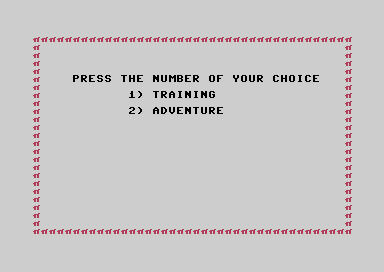
The copy is a Mindscape disk. It shows the Mindscape logo and asks for Training or Adventure; each has its own set of files. This site covers the Adventure. Its loader reads six files and moves some of them under the Commodore's input and output chips and its operating system ROM, until the game fills memory from $0400 to $FFF8.
Footprint
Every byte of the C64's 64 KB, one pixel each, 512 to a row. Lit pixels are what this game is: its code, graphics, level data, sound, text, tables and variables, exactly where they sit in memory. Dim areas are screen and working memory; dark is unused.
This game is in 2 parts, and the map is of one of them: Adventure. The Source tab has the listing of each part that has one.
Status
| Tier | gold |
|---|---|
| Coverage | 100 % of the bytes the game uses have a description |
| Comments checked | Not audited. No audit has checked every comment, and the last sample of 80 comments had 8 wrong, so between 5 and 19 % of the listing’s comments are likely wrong. How listings are checked |
| Media | The disk side holds 20 files and 2 runs of sectors no file holds. Of those, 12 are in the listings, 4 are data the game loads, 3 load the game, 2 are never loaded and 1 is not explained yet. Still open: track 2, sectors 10-11. |
| Build analysed | Mindscape disk, 20 files, SHA-256 d61d133d231b6453d4c409f0ff8d058771493b9030384a7d1c67758fee873b54 |
| Copy | human-edited |
| Tools | emulator: release v3.13.1 (the Adventure) and v3.14.0 (the Training part), linux-x86_64-gui.zip (vice-mcp), disassembler: regenerator2000 0.9.20, host: Linux 6.18 (Ubuntu 24.04 cloud container, no display), x86_64 Intel Xeon |
| Model | claude-opus-5-5 (Claude Code: the Adventure by a lead and eight annotation subagents; the Training part by one agent and a checker) |
| Kit version | 0.0.44 |
How the listing was checked
Every step that measured the Source tab’s comments or made them more accurate, in the order it happened, with the models that did it. Accuracy of the Source explains each step and what the row above makes of them.
| Step | By | What it found | Of the listing |
|---|---|---|---|
| Research | claude-opus-5-5 | Looked the game up online (its manual, reviews or wiki pages) before reading its code. | |
| Annotation | claude-opus-5-5 | Wrote the listing’s comments. lead and eight annotation agents | |
| Annotation | claude-opus-5-5 | Wrote the listing’s comments. 100 % of the program is described, in 2,946 comments. the Training part, one agent | |
| Sample 1 | claude-opus-5-5 | 8 of 80 comments wrong, so between 5 and 19 % of the listing is likely wrong. All 8 were then corrected. the Training part's listing |
likely wrong the sample’s range corrected right, or likely right not yet measured
Contributors
- unorig (4 commits)
- air (16 commits, 3 to this game alone)
- Gregg Barnett — game design and programming (the C64 manual, Lemon64's copy, read 1 October 2026)
- Greg Holland — backgrounds and scenery (same source)
- Russel Comte — character animations and sprites (same source)
- Nigel Spence, Trevor Nuridin and Bruce Bayley — graphic arrangements (same source)
- Neil Brennan — original music (same source)
- Bruce Bayley — sound effects (same source)
Other places to love this game

Sources
- The Melbourne House manual for the C64 cassette: Lemon64's copy (image), read 1 October 2026, and Gamebox64's scans of the leaflet and the supplementary instructions (scans), read 2 October 2026: the story, the credits, the controls, Chi, the trigrams, the enemies and the Tournament.
- "FIST 2 the legend continues: Guide to the entire game", a text guide by the Lemon64 member exploding fist64, posted on the Lemon64 forum on 2 March 2018: the order of play and the rooms where the scrolls are activated.
- A hand-drawn map of the game by Master Lee and hiTCH-HiKER, December 2008, given by the contributor: the key's names for the eight scrolls' powers.
- Magnus Andersson's walkthrough on GameFAQs, May 2007: the crossing at the waterfall.
- A player's comments on the Lemon64 forum, given by the contributor on 1 October 2026: enemies coming back after a number of defeats, from play on the cassette version.
- Wikipedia, "Beam Software", read 1 October 2026: the studio's other games.
- Search-result summaries of archive.org, Lemon64 and the Finnish Retro Game Comparison Blog, read 30 September 2026: the publishers and the two titles.
- Mallo, "Fist II: The Legend Continues, Commodore 64", The King of Grabs, 19 January 2023: a review of the C64 version.
- The US manual, Fist: The Legend Continues, Mindscape, 1986 (PDF at Games Database), read 1 October 2026: the Training rules. It names no one, only Beam Software, Melbourne House and Mindscape.
- "Fist II: The Legend Continues", Super Chart Island, 13 April 2026, given by the contributor: the Gallup chart, the C64 magazine reviews it quotes, and Gregg Barnett's words to Retro Gamer.
- "The Way of the Exploding Fist", Super Chart Island, 15 September 2025, given by the contributor: the first game's twelve weeks at the top of the UK chart.
- Andreas, "Interview with Nigel Spencer", C64.com, 4 January 2011, given by the contributor: the screen editor and the levels.
- Neil Carr, "An interview with Neil Brennan", Remix64, 28 November 2020, given by the contributor: how he composed for Beam's games. It does not mention Fist II.
- Helen Stuckey, Remembering Australian videogames of the 1980s: what museums can learn from retro gamer communities about the curation of game history, PhD thesis, Flinders University, 2016 (at the Internet Archive), given by the contributor on 2 October 2026: Bill McIntosh on the trapdoor and the nine warriors (from his 2006 interview for ACMI), and Gregg Barnett as Beam's Commodore expert.
What the game does, and where we found it
Read this before annotating code. What the game is documented to do, with verification status against the binary. Statuses: open (documented, not found yet), traced (in the code, could not be exercised; say what was tried), confirmed (in the code, consistent with the emulator), live (observed directly), differs (the code does something else). "Absent" is not a status.
Sources:
- The contributor allowed looking the game up online. On 30 September 2026 this session's network refused every game site it tried (archive.org's copy of the Mindscape manual, Lemon64, CSDb, GameFAQs, C64 Online, the FRGCB blog). What is below comes from web search result summaries of those pages, read the same day: leads, weaker than a page.
- The C64 manual, Lemon64's docs image, given by the contributor on 1 October 2026 and read in full: story, enemies, Chi, meditation, trigrams, controls, Tournament and credits. It replaces the summaries below wherever they differ.
- Search summaries of archive.org ("Fist: The Legend Continues", Mindscape manual text), Lemon64 and the FRGCB blog: developed by Beam Software, published by Melbourne House (UK) and Mindscape (US), 1986.
- Wikipedia's "Beam Software" article, read 1 October 2026: a Melbourne studio working for Melbourne House; its 1980s list includes The Hobbit, Sherlock, The Way of the Exploding Fist (Gregg Barnett, 1985), Rock'n Wrestle (1986), Shadows of Mordor (1987) and Samurai Warrior (1988), each released on the C64. The Overview's list of Beam's other games comes from here. Programming Gregg Barnett, music Neil Brennan, graphics Russel Comte and Greg Holland. The Warlord rules from a volcanic stronghold; the Fist Masters hid their secrets on scrolls and built shrines and temples for meditation. Find eight scrolls and bring each to its meditation chamber; the scrolls' power opens the way to the volcano. The life bar refills slowly outside fights; meditation rooms refill it and are respawn points. The C64 cassette's second side held a "Combat Practice Program".
- The same summaries on the controls: left and right walk; fire with a direction back turns round; up evades a sweep and climbs stairs; down ducks or climbs down; without fire, up-forward is a high punch and down-forward a jab; with fire: up a flying kick, up-forward a high kick, up-back a back kick, forward a mid kick, down-forward a low kick, down a sweep, down-back a rear sweep; a roundhouse kick.
- The game's own screens: the menu (Training, Adventure), the title.
Features
| Feature | Status | Where |
|---|---|---|
| Two modes on the disk: Training and Adventure | live (menu) | LL at $9800 |
| A large scrolling world of screens and areas | live (jungle, stone wall); 123 screens, 48 areas | $4A71, $4AEC |
| Walk left and right | live | move map $33C3 |
| Turn round with fire and back | traced | $33C3 |
| Up: evade, climb stairs; down: duck, climb down | traced | $33C3, $33E3 |
| Punches and kicks by joystick position, with and without fire | confirmed (flying kick, sweep live) | $33C3, move scripts $AF46 |
| Opponents fought one to one, with attack combinations | confirmed (one fought live) | $2E0E-$32F8 |
| Dogs and other hazards | traced: hazard objects cost 2 or 10 energy and can be knocked away | $2A57, $2BB4 |
| A life bar that refills slowly | confirmed (47 at the start live; +1 every 128 frames traced) | $2D14 |
| Eight scrolls to collect | traced | flags $0405-$040C |
| Meditation chambers: refill, respawn point, progress kept | traced: rooms $44-$4B; meditation raises the maximum by beaten opponents; respawn in the last chamber | $396F, $2D33 |
| Lives | live: 1 at the start; traced: +1 per scroll delivered | $2D32 |
| Puzzles around scrolls and shrines | traced in part: area 5 drains the hero unless scroll 8 is delivered | $2CE4 |
| The Warlord in the volcano | open: an ending scene is reached from room $7A ($2DB5), not tested | |
| Score and high score | confirmed (score rises on a hit, live) | $CC01, $CC21 |
| Music, three tunes by zone | confirmed (tune 3 in the jungle) | $F400 |
| Sampled sound effects | traced | $3D8B, $3DB8 |
| RESTORE pauses | live | $3C23 |
| F5 restarts | traced | $2444 |
| Training / combat practice mode | confirmed: a separate load, analysed as the part training (below) | LOADIT, parts/training |
Training
The part training; addresses are that part's (parts/training/facts.md).
| Feature | Status | Where |
|---|---|---|
| One player against the computer: beat each opponent twice to go up a dan | traced | one_player_game $1E45, wins_needed $D1 |
| Ranks NOVICE, then 1ST to 10TH DAN; endless past 10TH DAN | traced | show_rank $2436, one_player_endless $1EFE |
| Two players: "eight sixty-second rounds, two in each of four locations" (manual) | differs: four rounds of 60 seconds, one in each location | two_player_game $1DA6, $1DEF |
| Points for every strike that connects | confirmed: a full point the move's hundreds, a half point half | add_score $22A7, move_points $1297 |
| Points for the time left after a knockout | traced in a one-player game, 100 a second; a two-player knockdown scores the last hit again instead | time_bonus $241A, two_player_bout $1E18 |
| Four locations, each with its own picture and colours | live (the temple); traced | load_location $21C4, pictures $3CE2-$74FF |
| A demonstration between games | traced | demo $1F5D |
| Keyboard play (F7) and joystick | traced | read_keyboard $2AF8, read_joystick $2AB8 |
| Samples on and off (DEL) | traced | read_function_keys $20F4, samples_off $EE |
| RESTORE pauses | traced | nmi $32C4, pause_flag $1166 |
| Music: a tune for the demonstration and each mode | traced; a fourth tune is never played | music_update $09A5, tune $FF |
Beyond the documentation
- The game runs two tasks on two stacks: the scrolling is done by a background task that the interrupt switches to.
- Fighters are stored facing one way and mirrored as they are unpacked.
- The fighters' sprites are split down the screen in one of seven layouts.
- A second fighter on joystick port 1 is wired into the input routine.
- Training keeps the scoring of The Way of the Exploding Fist, half and whole point symbols, with nothing calling it (parts/training,
$1FEF). - Training's four samples lie in the bitmap under its one-colour floor, with a fifth sound beside them that nothing plays (parts/training,
$FCD3).
Open questions
See parts/adventure/facts.md, Open questions.
Outside sources checked on 1 October 2026
- Magnus Andersson's GameFAQs walkthrough (final version, 30 May 2007; gamefaqs.gamespot.com/c64/571009-fist-the-legend-continues/faqs/48570), read through a fetch summary with quoted sentences. It collects every trigram "without using the "restore cheat"-trick at the waterfalls"; numbers 39 enemies, the last two "Warlord 1" and "Warlord 2, glowing mask"; wolves "won't kill you, just drain your energy"; a trigram stops the "green radioactive (or poisionous, I don't know) chamber" draining energy (scroll 8,
$2CE4, agrees); one gives night vision in the pitch-black place (scroll 7,$10E5, agrees); and "Fall down into the hole, and the game is completed". Checked against the tables: the volcano rooms 60, 61 and 63 each hold an opponent record, and the way on from 63 to the ending, room 122, is an exit of type 3 (stick up and right at column 69), not a hole; what the player sees there has not been watched. The RESTORE key pauses the game ($3C23); how a pause would help at the waterfalls is open. The count of 39 has not been compared: the encounter table has 40 opponent records (flags bit 6 clear), and hordes add opponents beyond them. - Mallo's review on The King of Grabs (19 January 2023, C64): developed by Beam, "mostly by the same people who made Fist One", published by Melbourne House in 1986, music by Neil Brennan; "bugs that make defeated enemies re-appear" (the code makes this deliberate,
$2820); "no end game screen, and no title screen" (the Mindscape disk studied here shows a title picture while loading, and the ending is the final scene$2DB5; the review's copy is not named); a one-on-one tournament version "given away for free on side two". - The Mindscape manual for the US release, Fist: The Legend Continues (gamesdatabase.org PDF, filed under Melbourne House; read through a fetch summary with short quotes, 1 October 2026). Copyright Beam Software, "From Melbourne House Publishers Ltd", Mindscape; no individual credits. It describes the disk's Training mode: one player "must defeat each opponent twice to advance to the next dan"; two players fight "eight sixty-second rounds, two in each of four locations"; points for every strike that connects and for time remaining after a knockout. It lists the trigrams in the same order as Lemon64's copy and adds that meditation "cures poison", and "underwater hazards" among the dangers. Neither of these two has been checked in the code.
- The pasted text guide ("FIST 2 the legend continues Commodore 64/128 Guide to the entire game") is by the Lemon64 member exploding fist64, linked from lemon64.com/forum/viewtopic.php?t=67329 (2 March 2018) as a Google Drive document; the contributor confirmed the thread from a screenshot on 1 October 2026.
- Gamebox64's scans of the Melbourne House cassette manual (two leaflet pages and a supplementary sheet, MH 352/353; given by the contributor on 2 October 2026, copies in the project files, not committed). The same text and credits as Lemon64's copy, plus: the tape loads with the "PAVLOVA" fast loader in about 3 minutes; RESTORE pauses and pressing it again restarts play; F5 "will terminate the game, and return you to demo mode" (the disk restarts instead,
$2444); "you will be unable to smash through strong barriers ... with insufficient Chi" (the barrier test$0A2Ereads no energy); a poisoned hero "will not regain Chi" until meditation cures him (no poison state found; regeneration$2D14tests none); Chi drains "underwater, and in poisonous gas chambers" (area 5,$2CE4); entering a temple, the hero walks to the shrine by himself, and fire ends the meditation; sweeps and somersaults are "restricted" in swamps and river currents; some opponents "will still pursue you even if you choose to run"; shoguns often follow "hordes of warrior guards" (hordes,$27A1); the main game is joystick only, in the rear port. The swamp, current and pursuit claims have not been checked in the code.
- Read 2 October 2026, given by the contributor: Super Chart Island's pages on Fist II and The Way of the Exploding Fist (Gallup number one for the week ending 18 October 1986, one week; the first game twelve weeks; C64 reviews in Commodore User, Your Commodore and Zzap!64; Barnett's "reskin" remark to Retro Gamer), C64.com's 2011 interview with Nigel Spencer (screen editor, packing the levels into memory) and Tsumea's interview with Gregg Barnett (joined Beam in 1982). Reviews in Computer & Video Games and Your Computer were left out because the version reviewed is not stated. Super Chart Island also reports a reviewer's complaint about the hero getting "stuck in a loop while the screen moves" and no death message; neither has been checked in the code.
- Remix64's interview with Neil Brennan (Neil Carr, 28 November 2020), given by the contributor on 2 October 2026: his working method with Fred Milgrom and a 4-track; it says nothing about Fist II itself.
- Helen Stuckey's PhD thesis (Flinders, 2016), given by the contributor on 2 October 2026: Bill McIntosh's trapdoor and nine warriors (trapdoor confirmed in room 76,
$0659/$0660; warriors not found, no horde record in$E609); Barnett as Beam's Commodore expert; the Tsumea interview by Souri dated 2014. Its story of a hidden figure in Fist II's shrubbery is about the Spectrum version and was left out.
Each part of the game has its own symbol map and listing: Adventure, symbols.json and listing.json; Training, symbols.json and listing.json. Write-ups, facts and symbol maps are CC BY-SA 4.0. The game itself is not hosted here.