01 · The game
Run to the engine
Hijackers have taken over an express train. You chase them across the carriage roofs, then enter the train and work forward to the engine. In the engine room, reach the brake, then return to the left edge to stop the train.
Jump into a pursuer to knock him away. Duck under knives, leap over gaps, and catch a bird to throw back at your enemies. This is Csabo’s Plus/4 conversion of Stop the Express, with graphics by Chronos.
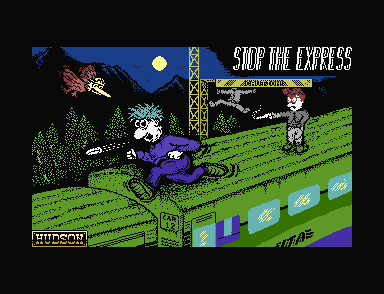 The supplied 2021 version requires a 64 KB Plus/4.
02 · The title music
Music: two voices from an eight-part score
The title tune returns to the start after 3,072 music steps. A music step advances the note counters. Two parts play through TED, the Plus/4’s sound chip. The music code also writes three parts for a SID card and three for DigiMuz hardware. These are optional sound expansions.
Loading the TED score…
The full TED part, produced by the original music code at $9D32, $9D35, and $9D38. Each PAL video frame advances the notes once and updates the sound twice. PAL is the video timing used here. This player presents the TED parts; the SID and DigiMuz parts need separate sound models.
Addresses such as $9D32 name places in memory. The $ means the number uses base 16, with digits 0–9 and A–F. The two sound updates occur as the display reaches screen lines 3 and 203. A phrase is a short list of music commands. A phrase can change the instrument, note length, and volume curve before giving a note. The volume curve says how loud the note becomes as it plays. Those settings carry into the next note. Each of the eight parts has a list that chooses its phrases. All eight lists share the same loop length: $A521–$A6B9.
DigiMuz needs pitch values in two memory tables at $FC00/$FC60. In this run, those locations hold alternating values $00 (0) and $FF (255) at game entry. Music initialization and a full tune leave them unchanged. Their preparation for physical DigiMuz hardware remains unverified.
03 · In play
Sound: the train keeps its own rhythm
The train’s hiss follows a stored rhythm. Short pitch lists supply the bird catch, brake, enemy defeat, and deaths. The buttons run those sound routines with one update per PAL video frame (about 20 ms) for comparison; the game’s own effects follow the speed of its repeated play updates.
Loading effects…
The five lists at $6D63–$6DD6, jump at $2267, wire-death sweep at $228E, train rhythm at $44D4, and bonus at $3527.
04 · The picture
One frame, rebuilt from memory
Each visible figure is made of little character squares, just like the letters in the score. A character code is the number that selects a square. TED draws a screen of 40 by 25 squares. The game changes the character shapes to turn the same screen into a train.
A drawing routine builds the next screen at $1000. The routine at $20F5 copies cells that changed to the visible screen. A routine is a small piece of the program with a particular job. Each character code also chooses a colour from the table at $1400.
05 · Movement
Jumping moves the world past you
On the roof, your runner usually stays in column 19. Moving left or right shifts the carriage picture and the other figures. After forty column steps, the counter that tracks progress along the carriages changes. In the engine room, the runner can move across the screen.
The vertical steps are stored as one-byte numbers that can move the runner up or down. A byte holds eight binary digits. The lists start at $38F7 and $3906. The page reads those lists and checks the resulting positions against the original movement routine. Each press advances one movement update, not one guaranteed video frame.
A roof attack succeeds when the runner’s row is 6 and a walking or throwing enemy falls inside the four-column contact window. That defeat pays 300 points. A released bird pays 100. Contact with those enemies at other rows kills the runner, or flashes the spare lives in practice: $4A03.
06 · Controls
The keyboard follows a direction pad
The game’s scrolling instructions spell the duck keys as M, <, and >. The keyboard scan uses the comma and full-stop positions. M also fades the title music, so the same key serves two purposes: $1ED0, $214D, and $4F29.
07 · Train data
Four trains share the route
Pairs of rounds share a train design. After the fourth pair, the designs repeat. The roof and interior each use a 40-column carriage pattern, copied into a working template before scrolling.
Thirteen rows of character codes per carriage, starting at $544F. The graphics decoder matches all twelve design/stage states loaded by the native program. Browse both stages and every final engine view.
The loader at $201E reads eight rows of dots and a colour for each character. The colour byte also holds a flag in its highest binary digit. When that flag is set, the loader leaves the existing character and colour in place. That lets the interior replace only the shapes that change. Inspect every character and moving figure.