01 · game
Two bodies share one escape
In 2215, the corporation Centro-Holographix turns chosen people into holograms and sends them out to kill for it. Between missions it keeps them in a computer. That computer fails while it holds its two strongest holograms, Hammerfist and Metalisis, and sends them out on one last mission: to destroy Centro-Holographix.
You play both of them. Hammerfist punches, and with his fist charged he fires a laser or swings a piston fist. Metalisis kicks and turns somersaults, which the manual calls flic-flacs, and reaches ledges he cannot. Most doors stay shut until their security system is smashed. All the while the Master of Centro-Holographix watches from the middle of the status panel.
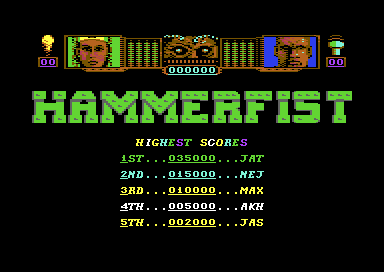 The title screen. The two portraits and the Master’s eyes stay above every room.
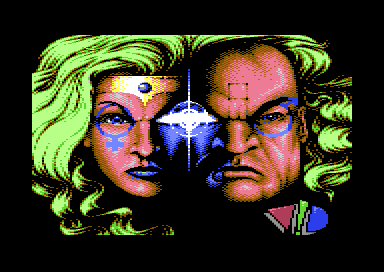 The loading picture shows the pair: Metalisis on the left, Hammerfist on the right.
02 · bodies
A resting body heals only far enough to be swapped back in
Pushing the joystick up swaps bodies. Each body keeps its own energy, up to 224 points, so a battered Hammerfist can step aside while Metalisis fights on.
The body that is resting heals by itself, one point every sixteen frames, about three points a second. It stops at 33. The swap needs exactly that: the game refuses to bring in a body with less than 33 points. So a body that has run dry comes back after about eleven seconds, with just enough energy to take over and no more.
Real healing comes from icons that defeated enemies drop and from recharge points in the scenery, two points a step. Charging past 224 is a mistake: the body explodes, loses all its energy, and the game swaps to the other one. One room is the exception.
Watch both bodies move on the Graphics tab →
The resting body gains its point in the status interrupt at $6754. The swap test at $8C2A compares the other body’s energy with $21, which is 33. A recharge step is at $9159.
03 · loads
Four disk loads take the pair from Complex 7 to the surface
The game is too big for the C64’s memory, so it comes from the second disk side in four loads. Each load brings its own eight rooms, its own enemies, and its own copy of most of the code. When you walk out of the last room, the game types a message naming the place you are leaving and the place you are entering, then loads the next part.
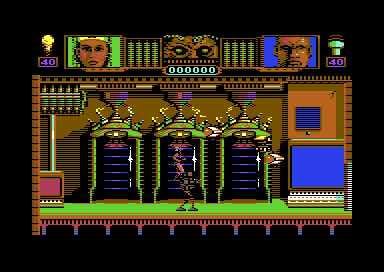 Load 1 · Complex 7. The message that ends it.
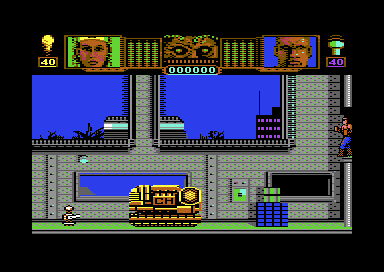 Load 2 · Docking area to sea floor. The message that ends it.
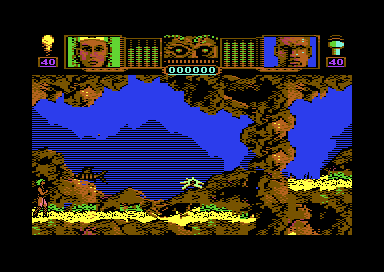 Load 3 · Mining area to air shaft. The message that ends it.
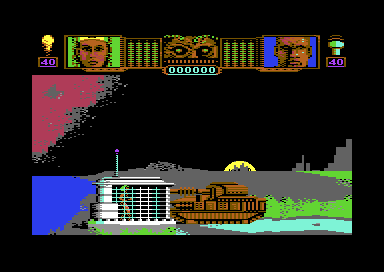 Load 4 · Surface city. The ending.
The loads also act as checkpoints. Each one keeps its own title screen, so a game over starts you again at the beginning of the load you reached, not back in Complex 7. The game remembers your score from the moment you arrived, and gives it back.
Every room of every load is on the Maps tab →
Click a message to type it again. The letters are drawn in the game’s own font and colours, two frames to a letter, as its slow text printer at $1CF0 does. The first load’s message is at $668B; the score is saved for the next game over at $667B.
04 · music
Music: Wally Beben’s tunes
The game itself carries three pieces of music: the title tune, the tune that plays through every room, and a short jingle for walking out of an area. The loading screen plays a fourth tune from the first disk side. That side holds three more tunes, and nothing ever plays them. They have a section on Discoveries.
Each button runs the game’s own music routine and plays what it writes to the SID, the C64’s sound chip. The fourth load and the loading disk keep their own copies of the in-play tune and the jingle. The copies sound the same, so each tune has one button. Music routine $EEAE; the loading disk’s routine is at $EC4F.
05 · effects
Sound: every effect, named by when it plays
The sound chip has three voices, three sounds it can make at once. A new effect takes a voice that is free, or pushes out an effect that matters less: each effect has a priority. The buttons are named for the moment the game asks for each effect. Four of the eighteen are never asked for anywhere in the game, and the last of them makes no sound at all.
Each button asks the game’s own effect routine at $32DA for one effect. Low notes can be hard to hear on laptop speakers.